
A condensing furnace — also called a high-efficiency or 90+ furnace — has four unmistakable visual characteristics that distinguish it from a conventional 80% furnace. You can identify a condensing furnace in roughly 30 seconds, from 5 feet away, without opening a panel or touching anything. The number of visual identifiers you see confirms what you have: one identifier is a likely match, two is a strong match, three is a near-certain match, and all four is a condensing furnace.
The U.S. Department of Energy classifies high-efficiency heating systems by two features — “condensing flue gases in a second heat exchanger for extra efficiency” and “sealed combustion” — with an AFUE rating of “90% to 98.5%” (energy.gov). These internal features produce the four external identifiers described below. A condensing furnace is not just an efficient version of a conventional furnace. It is a fundamentally different combustion design, and the differences are visible from the outside.
The Four Instant Identifiers of a Condensing Furnace
| Identifier | Condensing (90%+) | Conventional (80%) |
| Exhaust vent pipe | White PVC, 2-3 inches diameter | Metal — galvanized steel or B-vent, 4-6 inches |
| Intake pipe (if sealed combustion) | Second white PVC pipe, same diameter | No intake pipe — draws air from room |
| Condensate drain line | PVC or vinyl tube running to floor drain or pump | No drain line — no condensation produced |
| Condensate pump (if no floor drain nearby) | Small plastic box with thin PVC tube exiting | No pump — nothing to pump |
1. White PVC Exhaust Pipe: The Unmistakable Sign
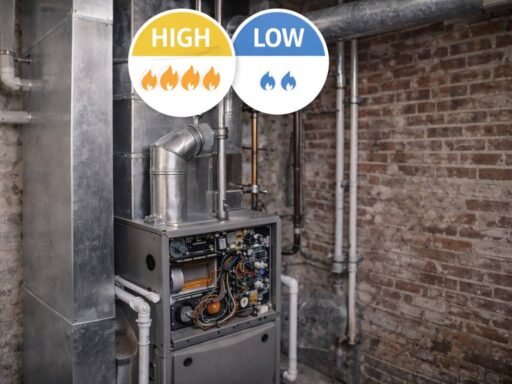
This is the single most reliable identifier of a condensing furnace. Look at the top or the side of the furnace cabinet. A white PVC pipe — 2 or 3 inches in diameter, the same type used for residential plumbing — exits the furnace and runs to an exterior wall, the roof, or the chimney chase. This is the exhaust vent, and it is made of PVC because condensing furnaces produce cool exhaust gases — typically 100°F to 120°F — that PVC can handle safely.
As the DOE notes, condensing furnaces “produce an acidic exhaust gas that is not suitable for old, unlined chimneys” and “PVC pipe… is safely used in condensing furnaces” (energy.gov). A conventional 80% furnace produces hot exhaust gases — 300°F to 400°F — that would melt PVC on contact. A conventional furnace vents through metal: galvanized steel vent pipe or a double-wall B-vent chimney. If the vent pipe is metal, the furnace is not condensing. If the vent pipe is white PVC, the furnace is condensing. This one identifier alone is correct roughly 95% of the time. The remaining 5% are mid-efficiency (78% to 83%) furnaces that were installed between roughly 1987 and 1993 with a high-temperature plastic vent pipe — not PVC, but a gray or black plastic that has since been recalled and must be replaced with stainless steel, per the DOE guidance.
2. Two Pipes Instead of One
If the furnace has two PVC pipes — not one — connecting to the cabinet, it is a condensing furnace with sealed combustion. One pipe is the exhaust. The second pipe, identical in diameter, is the combustion air intake. It brings outside air directly into the sealed burner compartment. As the DOE explains, “a sealed combustion furnace or boiler will bring outside air directly into the burner and exhaust flue gases directly to the outside, without the need for a draft hood or damper” (energy.gov).
A conventional furnace has no intake pipe. It draws combustion air from the room it sits in — the basement, the utility closet, or the attic — through open grilles on the front of the cabinet. A two-pipe condensing furnace draws its combustion air from outside and is not affected by negative pressure in the house from exhaust fans, range hoods, or clothes dryers. The two pipes typically exit the house through the side wall or the roof, terminating side by side. On the exterior, one pipe will be angled slightly downward (the intake) and the other will have a 45-degree or 90-degree elbow (the exhaust).
3. Condensate Drain Line: Water Coming from a Gas Appliance
A condensing furnace produces water. The second heat exchanger — the component that extracts the remaining heat from the combustion gases by condensing the water vapor in the exhaust — produces roughly 2 to 4 gallons of acidic condensate per day of heating operation. That water must drain somewhere. A PVC or vinyl tube, typically 3/4 inch in diameter, exits the furnace and runs either to a nearby floor drain or to a condensate pump.
A conventional 80% furnace produces no condensate. The water vapor in the combustion gases goes up the chimney as steam. There is no drain line on an 80% furnace. If you see a drain line — a small plastic tube running from the furnace to a drain or a pump — the furnace is condensing. This identifier is 100% specific: a conventional furnace does not have a drain line. A condensing furnace must have one.
4. Condensate Pump: The Small Box Next to the Furnace
If the furnace is in a basement or utility closet without a floor drain, the condensate must be pumped up to a higher drain line. A small plastic box — roughly 8 inches by 6 inches by 6 inches, often beige or gray — sits on the floor next to the furnace. A thin PVC tube exits the pump and runs upward, typically to a laundry sink drain, a standpipe, or a connection to the house’s plumbing drain system.
The condensate pump hums periodically when it runs — a brief electric motor sound lasting 5 to 15 seconds as it pumps the accumulated water out of the reservoir. The pump is not part of the furnace. It is a separate appliance that serves the furnace. The presence of a condensate pump next to a furnace is a strong indicator that the furnace is condensing, but it is not definitive — a conventional furnace with a whole-house humidifier may also have a condensate pump for the humidifier’s overflow. The combination of a pump plus a PVC vent pipe confirms a condensing furnace.
Model Number Confirmation: The Definitive Check
If the visual identifiers are ambiguous — the furnace is in a crawlspace, the vent pipe is hidden, or you want absolute certainty — the model number on the furnace’s rating plate provides the definitive answer. The rating plate is a metal or plastic sticker on the inside of the front panel or on the side of the cabinet. It lists the model number, the serial number, the BTU input, and the AFUE efficiency rating.
Google the model number. The search results will provide the manufacturer’s specification sheet, which includes the AFUE rating. A furnace with an AFUE of 90% or higher is a condensing furnace. An AFUE of 80% to 83% is a mid-efficiency furnace with electronic ignition — not condensing. An AFUE of 56% to 78% is a low-efficiency furnace with a standing pilot light. The number is definitive.
Condensing vs. Conventional: Quick Reference
| Feature | Condensing (90%+) | Mid-Efficiency (80%) | Low-Efficiency (56-78%) |
| AFUE | 90-98.5% | 80-83% | 56-78% |
| Vent pipe | White PVC, 2-3″ | Metal, 3-4″ | Metal chimney, large |
| Combustion air | Sealed — PVC intake from outside | From room, induced draft fan | From room, natural draft |
| Condensate drain | Yes | No | No |
| Second heat exchanger | Yes | No | No |
| Pilot light | No — electronic ignition | No — electronic ignition | Yes — standing pilot |
FAQ: Common Questions About Condensing Furnace Identification
My furnace has one PVC pipe, not two. Is it still condensing?
Yes — a condensing furnace with a single PVC pipe uses room air for combustion instead of outside air. This is a condensing furnace without sealed combustion. It is less efficient than a two-pipe system because it draws heated indoor air into the burner, as the DOE notes: “furnaces and boilers that are not sealed-combustion units draw heated air into the unit for combustion and then send that air up the chimney, wasting the energy that was used to heat the air.” A one-pipe condensing furnace still condenses exhaust gases, still has a second heat exchanger, and still has an AFUE of 90% or higher. It simply does not use outside air for combustion.
Can an oil furnace be condensing?
Yes, but they are rare in residential applications. Condensing oil furnaces exist and achieve AFUE ratings of 90% to 95%, but the acidic condensate from oil combustion is more corrosive than natural gas condensate, and the heat exchangers require more expensive materials to resist the acid. Most oil furnaces in the United States are conventional 80% to 87% efficiency units. The visual identifiers are the same: a PVC vent pipe, a condensate drain line, and a condensate pump.
PVC Pipe Plus a Drain Line = Condensing Furnace
Walk to your furnace. Look at the vent pipe coming out of the top or side. If it is white PVC — 2 to 3 inches in diameter — the furnace is condensing. If it is metal, the furnace is conventional. If there are two PVC pipes, it is a condensing furnace with sealed combustion. If there is a condensate drain line or a condensate pump, the confirmation is complete. These four identifiers — PVC vent pipe, second intake pipe, condensate drain line, condensate pump — identify a condensing furnace in 30 seconds without opening a panel.
Regular maintenance is particularly important for high-efficiency systems because they utilize more complex components than standard models. While some visual inspections can be handled by the homeowner, evaluating the precision of a two-stage valve or checking the integrity of a secondary heat exchanger requires specialized tools and expertise. Coordination with a qualified heating contractor helps ensure that these technical adjustments are made correctly, supporting the overall durability of the equipment. Consistent seasonal check-ups can also help identify minor wear before it affects the balance of airflow or increases fuel consumption during the coldest winter months.
While focus is often placed on the internal mechanics of a heating system, the surrounding infrastructure of the home also requires attention to maintain overall efficiency. Water leaks or drainage issues near heating equipment can lead to structural concerns and affect the moisture levels within the building. In cases where plumbing failures impact the mechanical area, it is helpful to have access to an emergency plumber who can address the source of the water intrusion before it compromises the furnace. Keeping the area dry and well-maintained supports the longevity of your heating unit and helps ensure that the system operates within its intended performance parameters.