
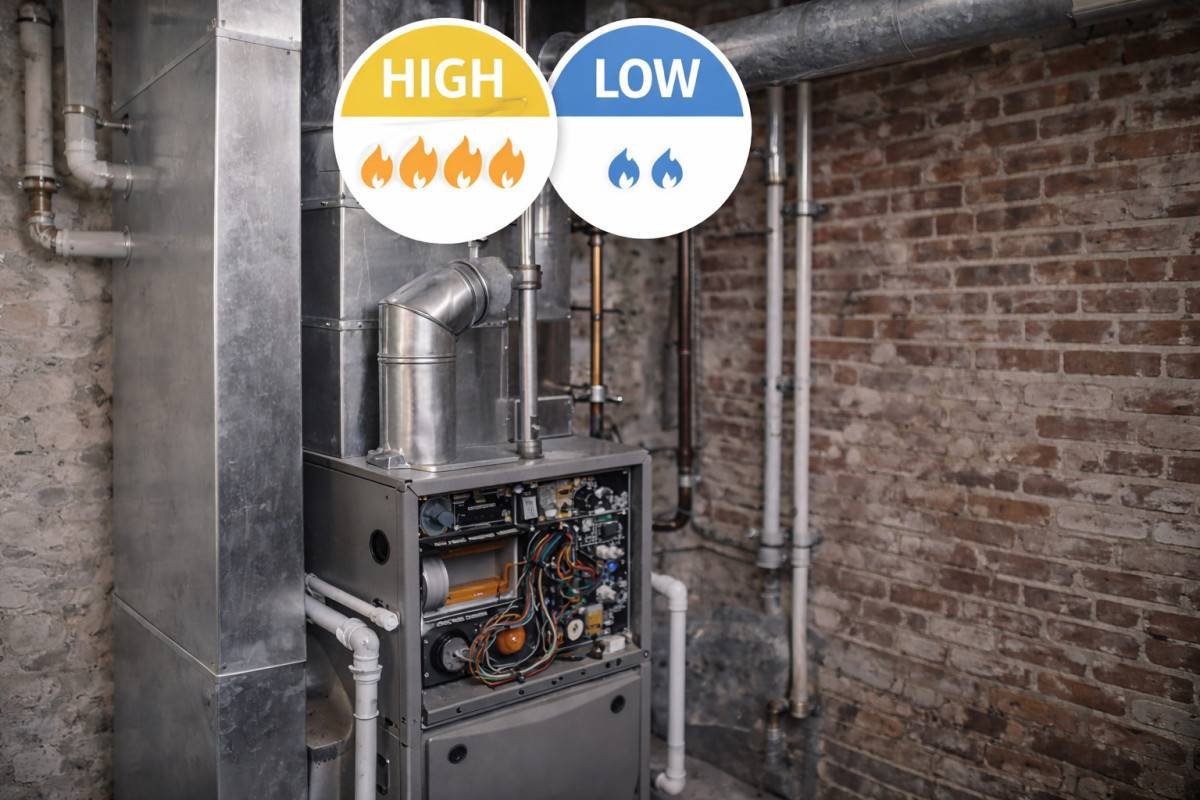
A two-stage gas furnace has two firing rates instead of one: a low-fire mode that runs at roughly 60% to 70% of maximum capacity, and a high-fire mode that runs at 100%. The furnace starts in low fire most of the time, stays there if the house warms up at a normal pace, and only switches to high fire when the thermostat detects that low fire is not keeping up — typically on the coldest days of winter or when the temperature is being raised by several degrees at once.
Where a single-stage furnace is a light switch (on or off), a two-stage furnace is a three-position toggle: off, low, and high. The result is longer, quieter, more efficient heating cycles that use roughly 30% less fuel than a single-stage unit on mild and moderate winter days. The Department of Energy classifies two-stage furnaces in the mid-efficiency to high-efficiency range, with AFUE ratings from 80% to 96%, depending on whether the furnace is a standard or condensing model.
The Two-Stage Gas Valve: The Heart of the System
The two-stage gas valve is what makes the furnace different from a single-stage unit. A single-stage valve has one solenoid and one orifice: when the thermostat calls for heat, the solenoid opens fully, gas flows at the maximum rate, and the burner lights at full capacity. There is no middle ground.
A two-stage valve has two solenoids controlling two separate internal orifices. The first solenoid opens a low-fire orifice sized for roughly 60% to 70% of rated capacity. The second solenoid opens a high-fire orifice that brings the total gas flow to 100%. The control board decides which solenoids to energize based on how long the furnace has been running and, in more advanced systems, on feedback from temperature sensors.
In most residential two-stage furnaces, the low-fire orifice is a fixed restriction machined into the valve body. The staging is not continuously variable — it is two discrete positions, and the furnace snaps between them. The transition from low to high fire is audible: the burner flame grows, the blower speeds up, and the furnace gets louder. In a modulating furnace, the transition is smooth; in a two-stage furnace, it is a step change.
Single-stage valve = 1 solenoid, 1 orifice, 100% fire only. Two-stage valve = 2 solenoids, 2 orifices, ~65% low fire and 100% high fire. Modulating valve = stepper motor, 130+ positions, 25-100% continuous range. The two-stage valve costs roughly 2x more than a single-stage and half as much as a modulating valve.
How the Furnace Decides When to Switch from Low to High Fire
Two-stage furnaces fall into two categories based on how they decide to shift from low fire to high fire: timer-based staging and algorithm-based staging.
Timer-based staging is the simpler and less expensive approach.
The control board starts every heating cycle in low fire and runs a countdown timer (typically 8 to 12 minutes, sometimes fixed, sometimes adjustable with a DIP switch on the board).
If the thermostat is still calling for heat when the timer expires, the board energizes the second solenoid and the furnace switches to high fire. If the thermostat satisfies before the timer runs out, the cycle ends in low fire.
The vast majority of cycles on a timer-based two-stage furnace end in low fire: on a 40°F day, a correctly sized furnace reaches the setpoint in 8 to 12 minutes on low fire alone.
Algorithm-based staging uses a communicating thermostat and a control board that tracks cycle history.
The board learns that on a Tuesday in December when the outdoor temperature is 28°F and the thermostat is calling for a 3°F rise, low fire typically satisfies the call in 14 minutes.
On a 10°F day, the board recognizes from previous cycles that low fire will not be enough, and it engages high fire after 5 minutes instead of waiting the full timer.
Trane calls this Comfort-R. Carrier calls it Adaptive Staging. The logic differs between manufacturers, but the fundamental principle is the same: use cycle history to minimize time spent in high fire.
Some advanced two-stage furnaces also accept a signal from an outdoor temperature sensor. The control board reads the outdoor temperature directly and pre-selects the staging strategy: below 25°F, start in high fire immediately; between 25°F and 40°F, start in low fire but allow an earlier transition to high fire; above 40°F, stay in low fire unless the cycle runs longer than 12 minutes.
The ECM Blower Motor: Why Two-Stage Furnaces Are Quieter and More Efficient
Nearly every two-stage furnace sold today pairs the two-stage gas valve with an electronically commutated motor (ECM) blower. An ECM blower uses a permanent-magnet rotor and a microprocessor-controlled inverter to vary its speed continuously across a wide range, drawing roughly one-third the electricity of a single-speed PSC (permanent split capacitor) motor at equivalent airflow.
When the gas valve is in low fire, the ECM blower runs at a lower speed to match the reduced heat output. The temperature rise across the heat exchanger — the difference between return air entering the furnace and supply air leaving it — stays in the design range of 40°F to 70°F. A single-stage furnace with a single-speed blower always moves the same volume of air regardless of how much heat is being produced. The blower does not know whether the burner just lit or has been running for 15 minutes.
The blower speed matching produces two practical benefits. First, the furnace is quieter in low fire because the blower is spinning slower and the burner is producing less flame noise.
The decibel difference between low fire and high fire is 10 to 15 dB on most models (roughly the difference between a refrigerator compressor and a dishwasher). Second, the ECM motor itself uses less electricity: roughly 150 to 250 watts on low speed versus 500 to 600 watts for a PSC motor on a single-stage furnace. Over a 1,500-hour heating season, that difference saves $50 to $100 in electricity.
Two-Stage vs. Single-Stage vs. Modulating: The Complete Comparison
| Feature | Single-Stage | Two-Stage | Modulating
|
| Firing rates | 1 (100%) | 2 (~65% + 100%) | 25-100% (1% increments) |
| Gas valve type | Single-solenoid | Dual-solenoid | Stepper-motor with PWM |
| Blower motor | Usually single-speed PSC | Almost always ECM | Variable-speed ECM |
| Temperature swing | ±3-4°F | ±1-2°F | ±0.5-1°F |
| Typical AFUE | 80-83% | 80-96% | 92-98.5% |
| Noise (low fire) | N/A (always full) | 50-60 dB | 40-50 dB |
| Installed cost | $2,500-$3,800 | $3,200-$5,000 | $5,500-$8,500 |
| Best for | Budget, rentals, mild climate | Cold climate, 7-15 yr home | Cold climate, forever home |
The two-stage furnace occupies the middle of the market for good reason. It costs roughly $800 to $1,500 more than a single-stage unit and delivers most of the comfort improvement that a modulating furnace provides at roughly half the price premium. For a homeowner in a cold climate who plans to stay for 7 to 15 years, a two-stage condensing furnace with 95% to 96% AFUE is the sweet spot: the energy savings recover the price premium, the comfort improvement is real and noticeable, and the equipment complexity stays manageable for most HVAC technicians.
How Much a Two-Stage Furnace Saves on Your Gas Bill
The savings from a two-stage furnace come from two sources: reduced fuel consumption in low fire and reduced electrical consumption from the ECM blower. The fuel savings are driven by longer, steadier cycles that eliminate the startup losses that occur every time a single-stage furnace fires at full blast. Each startup wastes roughly 5% to 10% of the gas consumed during that cycle because the heat exchanger has to warm up before useful heat reaches the ductwork.
| Furnace Type | Annual Gas Cost (2,000 sq ft, Cold Climate) | Annual Savings vs. Single-Stage 80% | Payback Period (vs. Single-Stage 80%)
|
| Single-stage, 80% AFUE | $1,200-$1,400 | Baseline | Baseline |
| Two-stage, 80% AFUE | $1,050-$1,200 | $150-$200 | 4-8 years |
| Two-stage, 95% AFUE condensing | $800-$950 | $400-$450 | 3-5 years |
| Modulating, 98.5% AFUE | $600-$800 | $600-$650 | 5-7 years |
A two-stage 95% AFUE condensing furnace hits the best return on investment for most homeowners. The additional cost over a single-stage 80% unit ($1,500 to $2,200) recovers through fuel savings in 3 to 5 years in a cold climate. The modulating upgrade from two-stage adds roughly $1,500 to $2,500 and delivers an extra $100 to $150 in annual savings — recovering its premium in 10 to 15 years. The modulating furnace is a comfort purchase, not a financial calculation.
Two-Stage, 80% AFUE: The Overlooked Option
Most two-stage furnace marketing focuses on the condensing models with 95%+ AFUE. But every major manufacturer also sells a two-stage 80% AFUE furnace, and in certain situations it is the smartest choice.
An 80% two-stage furnace costs roughly $3,200 to $4,500 installed — about $1,000 less than a 95% condensing two-stage unit. It vents through the existing metal chimney or B-vent, so there is no PVC pipe to run and no condensate drain to install. For a home in a moderate climate where the annual heating bill is $700 to $900, the extra $1,000 for condensing efficiency saves $100 to $130 per year — a 7 to 10 year payback on the condensate system alone.
The 80% two-stage furnace delivers the low-fire comfort (longer cycles, quieter operation, better temperature evenness) without the condensate plumbing. It is the right answer for homes where the furnace sits in a finished basement with no floor drain nearby, or where running PVC venting through a finished wall would cost more than the fuel savings justify.
FAQ: Common Questions About Two-Stage Furnaces
How do I know if my furnace is two-stage?
Check the model number label on the inside of the front panel. Two-stage furnaces often have a “2” or “V” in the model designation. Look for “two-stage” or “2-stage” printed on the label. You can also observe the furnace during a heating cycle: if you hear the burner and blower change speed once during a cycle (getting louder after 8-12 minutes of running), you have a two-stage furnace. A modulating furnace changes speed multiple times per cycle.
Do I need a special thermostat for a two-stage furnace?
For timer-based staging, a standard thermostat can control a two-stage furnace with two extra wires (W1 for low fire, W2 for high fire). The thermostat itself decides when to call for second-stage heat based on its own algorithm. For algorithm-based staging with the manufacturer’s Comfort-R or Adaptive Staging features, you need the manufacturer’s proprietary communicating thermostat, which adds $400 to $800 to the installed price.
How often does a two-stage furnace run in low fire vs. high fire?
In a cold climate, a correctly sized two-stage furnace runs in low fire roughly 75% to 85% of the time. It switches to high fire only on days below 25°F or when recovering from a deep setback. In a mild climate, the furnace may run in low fire 90% to 95% of the time — which is why the payback on a modulating furnace (which is most efficient at low fire) is so long in mild climates.
Why does my two-stage furnace whistle on startup?
The low-fire gas orifice is smaller than the single-stage orifice it replaced. If the gas pressure is set too high or the orifice is partially obstructed, the gas jet can whistle. The fix is to have a technician verify the manifold gas pressure matches the rating plate specification — typically 3.5 inches of water column for natural gas on low fire.
Can a two-stage furnace work with my existing single-speed blower?
No. A two-stage furnace requires a multi-speed or variable-speed blower to match the airflow to the two firing rates. Every two-stage furnace sold today includes an ECM blower motor. If an installer offers to put a two-stage gas valve on a furnace with a single-speed blower, they are selling a configuration that the manufacturer does not support and that will fail inspection.
My house only has two thermostat wires. Can I still get a two-stage furnace?
With only two wires, a two-stage furnace defaults to timer-based staging: it starts in low fire every cycle and shifts to high fire after the onboard timer expires. You will not get thermostat-controlled staging, but you still get the low-fire comfort benefit. Running a new thermostat wire bundle (18/8 gauge, roughly $200 to $400) is a worthwhile upgrade if you are replacing the furnace anyway — it gives you full two-stage control and prepares the wiring for future upgrades.
A Two-Stage Furnace Hits the Sweet Spot Between Cost and Comfort
The two-stage gas furnace is a five-word answer to the question of how to heat a house better without paying for a modulating system. It starts in low fire, runs quieter and longer, and only steps up to full output when the weather demands it — which, for most of the heating season, it does not.
A two-stage condensing furnace with 95% AFUE is the best financial choice for a cold-climate homeowner planning to stay 7 to 15 years. A two-stage 80% furnace is the best choice when condensate drainage or PVC venting would cost more than the efficiency upgrade recovers. In either case, the low-fire operation transforms the character of the heating system from a binary on-off cycle to something that ramps up only when it has to.
Maintaining a clean and healthy indoor environment involves more than just addressing immediate pest issues. Proper airflow and climate control also support general home maintenance by managing humidity levels, which can deter certain insects from nesting in dark spaces. For homeowners looking to optimize their overall indoor comfort alongside their seasonal pest control routines, consulting with home service professionals in Spring, TX can ensure that all systems are running efficiently. Ensuring a well-regulated home environment contributes significantly to keeping your living spaces healthy, dry, and comfortable throughout the year.
Closing off these hidden highways is a major step toward long-term relief. While many people focus on sealing the gaps around baseboards and cabinets, the spaces where utility lines and ductwork enter your living areas are often overlooked. Ensuring that your ventilation and climate systems are properly maintained can help limit the pathways these pests use to travel between rooms. Working with a dedicated team like Cool R Us, Inc A/C & Heating can ensure that your home’s infrastructure remains in good condition, which reduces the likelihood of insects finding easy nesting spots in dark, humid corners.
While addressing immediate pest issues is vital for a clean home, maintaining your indoor environment involves looking at multiple interconnected systems. Unwanted pests are often drawn to hidden areas, including neglected ventilation systems or spaces around heating units where moisture and dust accumulate. Keeping your climate control systems properly serviced can help reduce these hidden environments and improve overall indoor air quality. Homeowners can discover more about maintaining their heating and cooling equipment by consulting local system specialists to ensure a safe, comfortable, and well-regulated living space throughout the year.
Controlling indoor humidity is another vital step in making your home less attractive to these pests. High moisture levels often accumulate in areas with poor airflow, creating the damp conditions where cockroaches tend to thrive and reproduce. Maintaining your home’s climate control and ventilation systems can help reduce this excess humidity, especially in basements or laundry rooms. Keeping these systems in good working order supports a drier environment that discourages infestations from taking hold. To understand more about how seasonal maintenance can improve your indoor environment, you can learn more about professional system care and efficiency.