
A Frigidaire air conditioner that runs but does not cool has lost either airflow, refrigerant, or compressor function. The fan is spinning, the unit is making noise, but the air coming from the vents is room temperature or slightly warm. The failure is in the refrigeration circuit — the sealed system that absorbs heat from the indoor air and rejects it outside. The fan is working. The compressor is either not running, or it is running but the refrigerant is not circulating properly. The question is which one.
Before calling a technician, four zero-cost checks solve roughly half of Frigidaire no-cool problems: clean the air filter, verify the thermostat is set to COOL and the temperature is set 5°F below room temperature, check that the outdoor condenser unit or window unit exterior has at least 2 feet of clear air space on all sides, and listen for the compressor. If the unit hums but the compressor does not start after a few seconds, the capacitor or the compressor itself has failed. If the compressor runs continuously but the air is not cold, the problem is airflow or refrigerant.
1. Dirty Air Filter: The Most Common and Easiest Fix
A clogged air filter is the most frequent reason a Frigidaire AC stops cooling.
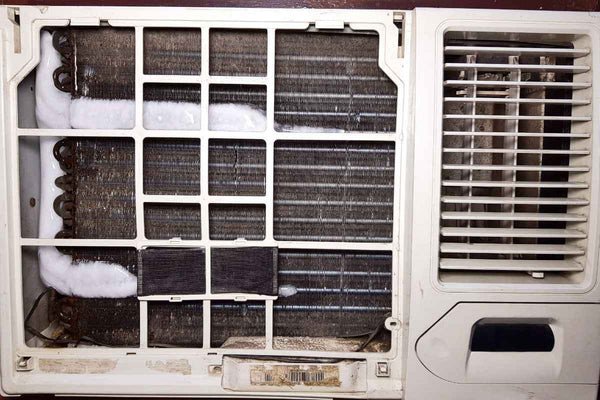
When the filter is packed with dust and debris, airflow across the evaporator coil drops. The coil temperature falls below freezing, ice forms on the coil fins, and the ice layer blocks the remaining airflow.
The compressor continues to run, but the air that reaches the room has passed through a block of ice, not through a cold coil. The air feels lukewarm and humid because it is not being cooled or dehumidified.
On a Frigidaire window or portable AC, the filter is accessible from the front panel or the side. Slide the filter out, rinse it under warm water until the water runs clear, and let it dry completely before reinstalling.
On a Frigidaire split system or central unit, the filter is in the return air grille in the ceiling or wall, or in a slot in the air handler cabinet. Replace disposable filters every 30 to 90 days. Clean washable filters monthly during the cooling season.
After cleaning the filter, leave the unit off for 30 to 60 minutes if the coil was frozen, running the fan only on high speed to speed the thaw.
Frigidaire Clean Filter indicator: Many Frigidaire window and portable units have a Clean Filter light that illuminates after 250 hours of operation. The light is a timer, not a sensor — it does not know whether the filter is actually dirty. If the light is on and the unit is not cooling, the filter has likely been overdue for cleaning. After cleaning the filter, reset the indicator by pressing and holding the FILTER RESET button (or the TEMP UP and TEMP DOWN buttons simultaneously on some models) for 3 seconds until the light turns off.
2. Thermostat and Mode Settings: The Overlooked Simple Fix
A Frigidaire AC that is set incorrectly will appear to not be cooling when it is actually operating in a mode that does not produce cold air. Three settings cause this confusion more than any mechanical failure.
Verify the mode is set to COOL, not FAN ONLY, DRY, or ECO. In FAN ONLY mode, the compressor does not run — the unit circulates room-temperature air. In DRY mode, the compressor cycles on and off to dehumidify rather than to cool, and the airflow feels weaker. In ECO mode, the compressor runs at reduced speed to save energy, producing less cooling than the COOL mode at the same temperature setting. Set the thermostat 5°F to 10°F below the current room temperature. If the unit reaches the set temperature quickly and shuts off, it is not broken — it is working correctly, and the thermostat was set too close to the room temperature.
On Frigidaire units with a remote control, low batteries can send incomplete infrared signals. The remote displays a temperature setting that the unit never receives. Replace the remote batteries and stand within 6 feet of the unit, pointing the remote directly at the sensor window on the front panel. If fresh batteries do not restore communication, try the manual control buttons on the unit itself. If the unit cools when controlled manually but not with the remote, the remote or the unit’s IR receiver has failed.
3. Dirty Outdoor Condenser Coil: The Heat Cannot Escape
The outdoor condenser coil — the metal fins visible through the grille on the back of a window AC, the outdoor unit of a split system, or the exterior-facing side of a portable AC — rejects the heat that the refrigerant absorbed from inside the house. When those fins are clogged with cottonwood fluff, dryer lint, grass clippings, or years of accumulated dirt, the heat cannot escape. The refrigerant stays hot, the compressor works harder, and the cooling output drops. A severely clogged condenser coil can reduce cooling capacity by 30% to 50%.
Clean the condenser coil at least once per cooling season. On a Frigidaire window AC, unplug the unit, remove the front grille and the outer casing, and gently brush the condenser fins with a soft brush and a vacuum. Spray the fins from the inside outward with a garden hose (not a pressure washer) to push debris out of the coil. Let the unit dry completely before plugging it back in. On a split system, the outdoor condenser unit has a metal grille secured by screws. Remove the grille, spray the coil from the inside outward with a garden hose, and straighten any bent fins with a fin comb ($8 to $15).
4. Frozen Evaporator Coil: Ice Blocking the Airflow
A Frigidaire AC that produces weak, lukewarm airflow may have a frozen evaporator coil. The coil freezes for the same reason as any other AC: inadequate airflow (dirty filter, dirty coil, blocked return, failing blower motor) or low refrigerant causing the coil temperature to drop below 32°F. Open the front panel of the indoor unit or window AC and look at the metal fins behind the filter. Frost or solid ice on the fins confirms a frozen coil.
Turn the unit off immediately. Switch the fan to high speed with the compressor off (FAN ONLY mode) and let the ice thaw completely — this takes 1 to 4 hours. Place towels under the indoor unit to catch the meltwater. Do not chip at the ice. Once the coil has thawed, clean the filter, clean the coil if it is dirty, and verify that all supply registers and return grilles are open and unobstructed. If the coil freezes again within days, the refrigerant charge is low and the system has a leak that requires an EPA-certified technician.
5. Compressor Not Running: Capacitor or Compressor Failure
A Frigidaire AC that hums for a few seconds, then goes silent without the compressor ever starting, has a failed capacitor or a seized compressor. The capacitor provides the electrical boost that starts the compressor motor. When the capacitor fails, the compressor draws locked-rotor current — a high-current hum — for a few seconds before the thermal overload switch cuts power to protect the motor windings. The unit sits silent for several minutes while the overload cools, then tries again, and fails again.
Listen to the outdoor unit or the back of the window AC when the thermostat calls for cooling. A brief hum followed by silence and a click is the capacitor. A continuous loud hum with no start is the compressor struggling against a mechanical lock. A unit that trips its circuit breaker when the compressor tries to start is a shorted compressor winding. A capacitor replacement costs $150 to $300. A compressor replacement on a window or portable Frigidaire unit costs $300 to $600 — which is often more than the cost of a new unit. A compressor replacement on a split system costs $1,200 to $2,500.
6. Low Refrigerant or Refrigerant Leak
A Frigidaire AC that runs continuously, the compressor is running, the airflow is normal, but the air is not cold has a refrigerant problem. The most likely cause is a slow leak that has gradually reduced the system’s charge over months or years. Air conditioners are sealed systems. Refrigerant does not get “used up.” If the charge is low, there is a leak.
Signs of a refrigerant leak include: the air from the vents feels cool but not cold, the suction line at the outdoor unit (the larger copper pipe wrapped in black foam) is not cold and sweaty during operation, ice forms on the evaporator coil or the suction line, and a hissing or bubbling sound comes from the indoor or outdoor unit. Window and portable Frigidaire units that are low on refrigerant are almost never worth repairing — the sealed system repair costs more than a replacement unit. Split-system units with a refrigerant leak should be evaluated by an EPA-certified technician. Leak repair and recharge costs $400 to $1,500.
7. Frigidaire Window and Portable AC Specific Issues
Frigidaire window and portable ACs have several failure modes that do not apply to split systems. These are the most common.
Window unit not tilted correctly. A window AC must tilt slightly toward the outside — roughly ¼ inch of downward slope per foot of unit depth — so that condensate drains to the outside of the window rather than pooling inside the unit. If the unit is level or tilted inward, water accumulates in the condensate pan, freezes on the evaporator coil, and blocks cooling. Adjust the mounting brackets to restore the correct outdoor tilt.
Portable AC exhaust hose disconnected or kinked. A portable Frigidaire AC uses a flexible exhaust hose to vent hot condenser air out a window. If the hose has become disconnected at either end, is kinked behind the unit, or is crushed between the unit and the wall, the hot air recirculates into the room. The unit fights itself: the evaporator cools the air, and the condenser immediately reheats it. Check the hose connection at both ends and straighten any kinks.
Window or portable unit undersized for the room. Frigidaire rates its window and portable ACs by BTU. A unit that is too small for the room will run continuously and never reach the set temperature on a hot day, producing air that feels cool but never makes the room comfortable. The DOE recommends 20 BTU per square foot of living space. A 150-square-foot bedroom needs at least a 5,000 BTU unit. A 400-square-foot living room needs at least an 8,000 to 10,000 BTU unit. Check the unit’s BTU rating against the room size. An undersized unit is not broken — it was the wrong size from the day it was installed.
FAQ: Common Questions About Frigidaire AC Not Cooling
My Frigidaire AC compressor runs but the air is not cold. What is wrong?
The compressor is running, so the capacitor and the electrical circuit are fine. The problem is either a dirty condenser coil preventing heat rejection, a dirty evaporator coil or filter restricting airflow, or low refrigerant. Clean the filter and both coils first. If the air is still not cold, the refrigerant charge is low and the unit has a leak.
Why is my brand-new Frigidaire AC not cooling?
A new Frigidaire AC that does not cool was either installed incorrectly or is undersized for the room. For a window unit, check that the unit is tilted toward the outside for proper drainage and that the side curtains are fully extended and sealed. For a portable unit, verify the exhaust hose is connected and not kinked. For a split system, the installation may have left air or moisture in the refrigerant lines because the lines were not vacuumed properly before the refrigerant was released — this requires the installing contractor to return and correct under warranty.
Troubleshoot in Order: Filter, Settings, Airflow, Then Refrigerant
A Frigidaire AC that is not cooling has failed at one of five points in the refrigeration cycle: the airflow across the evaporator coil, the compressor that circulates the refrigerant, the condenser coil that rejects the heat, the refrigerant charge itself, or the thermostat that controls the whole system. Clean the filter, verify the mode and temperature settings, clean the condenser coil, and check the airflow path. Those four zero-cost steps solve the majority of Frigidaire no-cool problems.
If the compressor is not running — listen for the hum, then silence — the capacitor has failed. If the compressor is running but the air is not cold, and the filter and coils are clean, the refrigerant charge is low. The capacitor is a $150 to $300 repair. The refrigerant leak is a $400 to $1,500 repair. For window and portable units, both numbers approach or exceed the cost of a replacement unit. For split systems, the repair is economically justified if the unit is under 10 years old.