
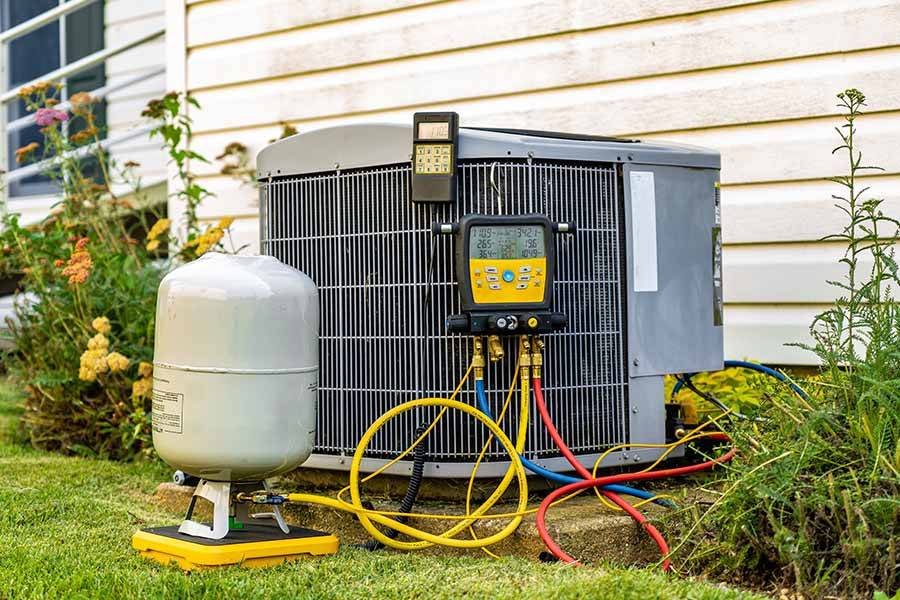
A hissing noise from an air conditioner is either a refrigerant leak — pressurized gas escaping through a pinhole in a coil, a braze joint, or a service valve — or the normal sound of refrigerant flowing through the system. The distinction between the two is critical. A refrigerant leak hisses continuously while the system is running, grows louder over days or weeks as the leak enlarges, and is accompanied by a gradual loss of cooling capacity. Normal refrigerant flow produces a brief hiss at startup or shutdown, a steady whisper from the indoor coil while the system runs, or a gurgling sound after the system cycles off as the pressures equalize. The leak is a problem. The flow is not.
The location of the hiss tells you as much as the sound itself. A hiss from the outdoor condenser unit is a leak in the condenser coil, a refrigerant line connection, or the compressor’s internal pressure relief valve. A hiss from the indoor air handler or furnace is a leak in the evaporator coil or the metering device, or it is the normal sound of refrigerant passing through the TXV (thermostatic expansion valve). A hiss that comes from the ductwork or the registers is an air leak, not a refrigerant leak. The AC refrigerant circuit is a sealed system. Air hissing from a duct has nothing to do with it.
Refrigerant Leak Hiss vs. Normal Refrigerant Flow Hiss
| Characteristic | Refrigerant Leak | Normal Refrigerant Flow |
| When it happens | Continuous while system runs | Briefly at startup or shutdown, or steady whisper |
| Volume over time | Gets louder as leak enlarges | Stays the same |
| Cooling performance | Gradually declining | Normal |
| Oily residue | Often visible at the leak point | None |
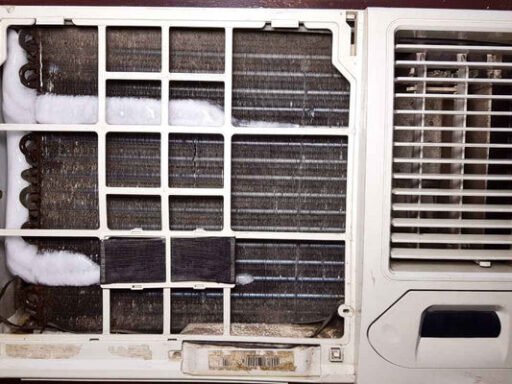
| System behavior | Coil may freeze, compressor may short cycle | Normal operation |
1. Refrigerant Leak: The Hiss That Gets Louder
A refrigerant leak produces a continuous hissing or whistling sound from the indoor evaporator coil, the outdoor condenser coil, or the copper refrigerant lines connecting them. The sound is pressurized refrigerant gas — typically R-410A at 100 to 400 PSI — escaping through a pinhole. The hiss is constant while the system is running and stops when the compressor cycles off. As the leak enlarges over weeks or months, the hiss becomes louder and may develop a higher-pitched whistle as the gas velocity through the opening increases.
The most common leak points on a residential AC system are: the evaporator coil (formicary corrosion — tiny pinholes caused by formaldehyde in the indoor air reacting with the copper), the braze joints where the refrigerant lines connect to the coils, the Schrader valves at the service ports, and the condenser coil (impact damage from a rock, a weed whacker, or a dog urinating on the coil). An oily residue at any of these points confirms a leak — refrigerant carries compressor oil, and the oil escapes at the leak point and collects dust, appearing as a dark, greasy spot.
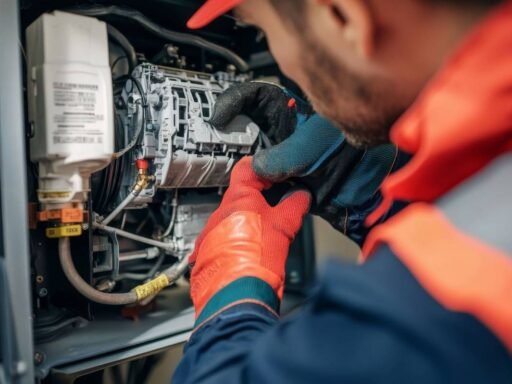
If you suspect a refrigerant leak, turn the AC off and call an EPA-certified technician. The leak must be located with an electronic detector or UV dye, repaired by brazing or component replacement, and the system evacuated and recharged to the precise weight on the nameplate. Leak repair and recharge costs $500 to $1,500. Do not use a can of stop-leak from the auto parts store. Automotive stop-leak compounds are not compatible with residential AC refrigerant, and they contaminate the system, void the compressor warranty, and turn a $500 leak repair into a $2,500 system replacement.
The dog urine problem: Dogs urinating on the outdoor condenser coil is a surprisingly common cause of refrigerant leaks. The uric acid in dog urine corrodes the aluminum fins and eventually the copper refrigerant tubes beneath them. The leak starts as a pinhole and grows. A condenser coil that has been damaged by dog urine must be replaced — the individual pinholes cannot be repaired. A condenser coil replacement costs $800 to $1,500. A plastic or metal guard around the base of the outdoor unit prevents this entirely for $50 to $100.
2. TXV Hiss: The Normal Sound of Refrigerant Metering
The thermostatic expansion valve (TXV) is a precision metering device at the inlet of the evaporator coil that controls how much refrigerant enters the coil. As high-pressure liquid refrigerant passes through the TXV’s small orifice and flashes to a low-pressure liquid-gas mixture, it produces a hissing or rushing sound. This is the normal sound of the TXV doing its job — metering refrigerant into the coil at exactly the rate needed to match the cooling load. The TXV hiss is a steady, low-volume whisper, not a loud hiss. It is heard at the indoor coil, not at the outdoor unit. It has been present since the system was installed and does not change in volume.
A TXV hiss that suddenly becomes louder, or a TXV that begins making a gurgling or chattering sound, is not normal. A failing TXV can stick open (flooding the coil, causing liquid slugging at the compressor) or stick closed (starving the coil, causing low suction pressure and coil freezing). A TXV that has failed must be replaced ($400 to $800). The refrigerant must be recovered, the old valve brazed out, the new valve brazed in, the system evacuated, and recharged.
3. Pressure Equalization Hiss After Shutdown
A hissing or gurgling sound from the indoor unit that lasts for 10 to 60 seconds after the compressor cycles off is refrigerant equalizing between the high-pressure side and the low-pressure side of the system. When the compressor stops, the pressure in the high side (the condenser and the liquid line) is 200 to 400 PSI. The pressure in the low side (the evaporator and the suction line) is 100 to 150 PSI. The refrigerant flows from the high side to the low side through the metering device until the pressures equalize. The sound of that flow is a brief hiss, gurgle, or rushing sound. It is normal operation on virtually every residential AC system. It is not a leak.
An equalization hiss is distinguished from a leak by timing: it happens immediately after the compressor stops and lasts for seconds, not minutes. A leak hisses continuously while the compressor runs. Equalization hisses after the compressor stops. If the equalization sound is unusually loud or prolonged — lasting several minutes — the system may have a non-condensable gas (air or nitrogen) in the refrigerant circuit, which requires evacuation and recharging by a technician.
4. Air Leak in the Ductwork: The Hiss from the Vents
A hissing or whistling sound from the supply registers or the ductwork is an air leak, not a refrigerant leak. The blower is forcing air through the ducts at a pressure of roughly 0.1 to 0.5 inches of water column — a tiny fraction of the hundreds of PSI in the refrigerant circuit. A gap in a duct joint, a loose register connection, or a pinhole in the duct wall produces a hiss as the pressurized air escapes through the opening. The hiss is loudest at the leak point and diminishes as you move away from it.
Air leaks are most common at the connections between the register boot and the drywall, at the joints between duct sections in the attic or crawlspace, and at the connections to the air handler or furnace plenum. Walk along the accessible ductwork while the blower is running. A hissing duct joint can be sealed with mastic or aluminum foil tape — not cloth duct tape, which dries out and falls off. A hissing register can be tightened or sealed with a bead of caulk around the boot-to-drywall gap.
5. Compressor Internal Pressure Relief Valve
Scroll compressors — the most common type in residential AC systems manufactured in the last 25 years — have an internal pressure relief valve that opens if the discharge pressure becomes dangerously high. When the valve opens, it bypasses hot discharge gas from the high-pressure side back to the low-pressure side inside the compressor housing, producing a loud hissing or rushing sound from the outdoor unit. The valve opens to protect the compressor from damage during a high-pressure event: a failed condenser fan, a severely clogged condenser coil, or an overcharge of refrigerant.
A compressor relief valve that opens occasionally on an extremely hot day with a dirty condenser coil is doing its job. Clean the coil. A relief valve that opens every cycle, or opens shortly after the compressor starts, indicates a persistent high-pressure problem that must be diagnosed by a technician. Continuing to run the compressor with the relief valve cycling will overheat the compressor and cause internal damage. Each time the valve opens, the compressor runs in a hot-gas bypass mode that generates additional heat and provides no cooling.
FAQ: Common Questions About AC Hissing Noises
My new AC makes a hissing noise that my old one didn’t. Is that a problem?
Probably not. Modern high-efficiency AC systems use a TXV metering device that hisses as it meters refrigerant. Older systems used a fixed-orifice piston that was quieter. The TXV hiss is a feature of the higher-efficiency design, not a defect. If the system is cooling normally, the hiss is normal. If the cooling performance is declining or the hiss is getting louder, have the system checked.
I hear bubbling or gurgling from the indoor unit. Is that a leak?
Bubbling or gurgling from the indoor unit after the system shuts off is refrigerant equalizing between the high and low sides of the system. It is normal and temporary. Bubbling or gurgling while the system is running, accompanied by poor cooling, may indicate air or non-condensable gases in the refrigerant circuit, or a low refrigerant charge causing the refrigerant to boil erratically in the evaporator. If the sound happens during operation and the cooling is poor, call a technician.
Leak Hiss Is Continuous and Gets Worse. Flow Hiss Is Brief and Stays the Same.
An AC hissing noise is either a leak or normal refrigerant flow. The leak hisses continuously while the system runs, gets louder over time, and is accompanied by declining cooling performance and possibly oily residue at the leak point. The flow hisses briefly at startup or shutdown, has been present since installation, and does not change.
If the hiss is continuous, the cooling is getting worse, and you see an oily spot on a refrigerant line or a coil, turn the system off and call a technician. If the hiss is a brief whisper at the indoor coil when the system starts, or a gurgle that fades after the compressor stops, the system is operating normally. The hiss of a leak is the sound of the repair bill growing larger every day. The longer the leak runs, the lower the refrigerant charge, the harder the compressor works, and the closer the repair approaches the cost of replacement.