
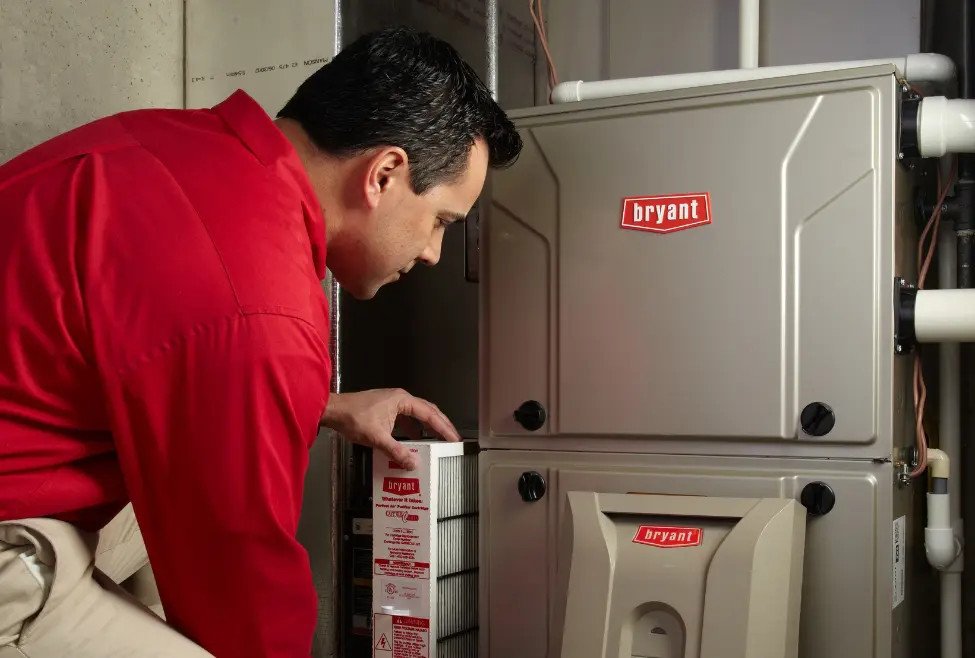
An oil furnace that starts, runs briefly, and shuts off before the house reaches the set temperature is almost always failing at one of two points in its operating sequence: the flame is being lost after ignition (the cad cell flame sensor loses sight of the flame and the primary control shuts off the burner), or the furnace is overheating and tripping the limit switch (the heat exchanger is getting too hot because airflow is restricted). The remaining causes — an empty oil tank, a clogged filter, water in the fuel, a failing fuel pump — prevent the burner from starting at all or cause it to run poorly before shutting down.
Oil furnaces are fundamentally different from gas furnaces in their failure modes. A gas furnace’s most common problems are electrical: a dirty flame sensor, a failed igniter, a failed control board. An oil furnace’s most common problems are fuel-related: a clogged nozzle, a dirty oil filter, water in the tank, air in the line. The oil burner is a precision mechanical device that atomizes fuel oil into a fine mist and ignites it with a high-voltage spark. When any part of the fuel delivery or ignition system degrades, the burner shuts down — either because the primary control detected a flame failure, or because the burner never produced a stable flame in the first place.
Oil furnace shutdown by the numbers: A clogged nozzle accounts for roughly 40% of oil furnace shutdowns. A dirty cad cell or faulty primary control accounts for roughly 20%. A dirty air filter causing limit switch trips accounts for roughly 15%. An empty tank, a clogged oil filter, or water in the fuel accounts for roughly 15%. The remaining 10% is divided among failing fuel pumps, failing ignition transformers, blocked chimneys, and cracked heat exchangers.
1. Out of Oil or Low Oil Level
An oil furnace that shuts off and will not restart may simply be out of oil. Unlike a natural gas furnace connected to an infinite utility supply, an oil furnace draws from a finite tank. When the tank runs dry, the burner shuts off. If the tank is not completely empty but is very low — below roughly 4 to 6 inches of oil in a 275-gallon above-ground tank — the fuel pickup tube may be drawing sludge and sediment from the bottom of the tank instead of clean oil. The sludge clogs the oil filter, the nozzle, or the fuel pump strainer, and the burner shuts down on flame failure.
Check the oil tank gauge. If the tank is empty, call your oil supplier for an emergency delivery. After the tank is filled, the fuel line must be bled to remove the air that entered the line when the tank ran dry. Bleeding the fuel pump is a 10-minute procedure that involves opening a bleed port on the pump with a wrench, catching the fuel-oil-and-air mixture in a container until it runs clear, and closing the port. Most oil burner primary controls have a reset button that must be pressed after a flame-out. Press the reset button ONCE. If the burner does not start and stay lit after one reset, do not press it again. Each press of the reset button sprays unburned oil into the combustion chamber. Pressing it repeatedly fills the chamber with oil, which can ignite explosively when the burner finally lights. One reset. One attempt. If it does not work, call a technician.
2. Clogged Fuel Nozzle: The Most Common Oil Furnace Problem
The oil burner nozzle is a small brass fitting at the end of the burner assembly that atomizes fuel oil into a fine, cone-shaped mist for combustion. The nozzle orifice is tiny — typically 0.50 to 1.00 gallons per hour, with an opening roughly the diameter of a pin. When the nozzle clogs with carbon, sludge, or debris from the oil tank, the fuel spray pattern degrades. The flame becomes unstable, the cad cell cannot consistently detect it, and the primary control shuts off the burner for safety.
A partially clogged nozzle produces a distinctive pattern: the burner starts, runs for a few minutes with a rumbling or pulsating flame, then shuts off. The primary control resets automatically and the burner restarts, repeating the cycle. A completely clogged nozzle prevents the burner from firing at all — the ignition sparks, the fuel pump runs, but no flame appears, and the primary control locks out after the safety timing period (typically 15 to 45 seconds). Nozzle replacement is an annual maintenance task that should be performed by a technician during a tune-up ($150 to $250). The nozzle itself costs $8 to $15. The labor and the combustion analysis that should accompany the replacement account for the rest.
3. Dirty or Failed Cad Cell (Flame Sensor)
The cad cell is the oil furnace’s equivalent of a gas furnace’s flame sensor: a small photoelectric sensor mounted in the burner housing that “sees” the flame. When the flame is present, the cad cell’s electrical resistance drops from several thousand ohms to under 1,500 ohms, and that resistance change tells the primary control that the burner is lit and it is safe to keep the fuel flowing. When the cad cell becomes coated with soot, oil residue, or combustion deposits, it cannot see the flame clearly. The primary control interprets the high resistance as a flame failure and shuts off the burner.
A dirty cad cell is cleaned by removing it from the burner housing (it is typically held by a single screw) and wiping the sensor face with a soft, clean cloth. Do not use solvent, abrasive cleaners, or steel wool — the sensor face is a delicate cadmium sulfide surface that scratches easily. If cleaning does not restore normal operation, the cad cell may have failed. A replacement cad cell costs $20 to $40 and takes a technician 15 minutes to install. Homeowners can replace a cad cell themselves — it is a plug-in component — but the primary control should be tested afterward to verify proper flame detection and safety lockout timing.
4. Dirty Air Filter: Overheating and Limit Switch Cycling
An oil furnace has the same limit switch protection as a gas furnace: when the heat exchanger temperature exceeds roughly 180°F to 200°F because airflow is restricted, the limit switch opens and cuts power to the burner. The blower continues to run to cool the heat exchanger, the limit switch resets, and the burner relights. The furnace cycles on its own limit switch rather than on the thermostat, never delivering enough continuous heat to satisfy the thermostat.
Replace the air filter. Clean the blower wheel if it is visibly packed with dust. Verify that all supply registers are open and that no return grilles are blocked by furniture, rugs, or curtains. An oil furnace with a clean filter, a clean blower wheel, and unobstructed airflow should not trip its limit switch under any normal operating condition. If it continues to cycle on the limit switch with a clean filter and open registers, the blower motor may be failing, the blower speed may be set too low, or the heat exchanger may be sooted internally and retaining more heat than normal. All three conditions require a technician.
5. Clogged Oil Filter or Fuel Pump Strainer
An oil furnace has two filters: a canister-style oil filter near the oil tank and a fine strainer inside the fuel pump. When either filter clogs with sludge, rust particles from the tank, or wax crystals that form in the oil during cold weather (a condition called gelling), the fuel flow to the burner is restricted. The burner may start and run for a short time before the fuel pressure drops and the flame becomes unstable. The cad cell detects the flame deterioration and the primary control shuts off the burner.
The oil filter canister near the tank should be replaced annually. The filter element costs $8 to $15. The procedure is: close the valve at the tank, unscrew the canister, remove the old filter, clean the canister, insert the new filter, replace the canister gasket, reinstall the canister, open the valve, and bleed the air from the line. A homeowner comfortable with basic plumbing and willing to handle fuel oil can replace an oil filter. The fuel pump strainer inside the burner is more difficult to access and is typically cleaned or replaced during a professional tune-up.
6. Water in the Oil Tank
Water accumulates in an oil tank through condensation — warm, humid air enters the tank vent, the tank cools at night, and moisture condenses on the interior walls and drips into the oil. Over years, a layer of water and sludge builds up on the bottom of the tank below the oil. When the oil level drops and the pickup tube begins drawing from the bottom few inches, it pulls water and sludge into the fuel line. Water does not burn. When a slug of water reaches the nozzle, the flame goes out, the cad cell detects the loss of flame, and the primary control shuts off the burner.
A furnace that shuts off intermittently — works fine for hours, then shuts down, then restarts and works fine again — with no pattern related to runtime or outdoor temperature is drawing water from the tank. The fix is to have the tank pumped out and the water and sludge removed by an oil service company ($200 to $400). A water-absorbing fuel additive can help manage small amounts of condensation but will not resolve a significant water accumulation. If the tank is buried underground, water intrusion may also indicate a leak in the tank, which is an environmental hazard and requires tank replacement.
7. Failing Ignition Transformer or Dirty Electrodes
An oil burner ignites the fuel mist with a high-voltage spark — typically 10,000 to 14,000 volts — generated by an ignition transformer and delivered to the fuel spray through two electrodes mounted at the nozzle. When the transformer weakens with age, the electrodes become coated with carbon, or the electrode gap widens from erosion, the spark weakens. The burner may light intermittently — starting on some cycles and failing on others — or the flame may be unstable and prone to being blown out by the combustion air stream.
A failing ignition system produces a pattern: the burner starts normally sometimes, fails to light other times, and occasionally lights but produces a rumbling or pulsating flame that the cad cell rejects. The primary control cycles through its safety timing and locks out. The ignition transformer and electrodes are internal burner components that require a technician to test and replace. A transformer costs $80 to $200. Electrode replacement and gap adjustment are included in an annual tune-up ($150 to $250).
8. Blocked Chimney or Flue: The Furnace Cannot Breathe
An oil furnace vents its combustion gases through a chimney or a metal flue pipe. If the chimney is blocked by a bird’s nest, a dead animal, collapsed masonry, or accumulated soot, the combustion gases cannot escape. The furnace’s draft — the natural airflow that pulls combustion gases up the chimney — drops below the minimum required for safe operation. Some oil furnaces have a draft safety switch that shuts off the burner when the draft fails. Others continue to run but produce soot and carbon monoxide that will eventually trigger a limit switch or soot over the cad cell and cause a flame failure shutdown.
A blocked chimney is a life-safety hazard. Carbon monoxide from incomplete combustion can back up into the house. If the oil furnace is shutting off and there is any indication of a chimney problem — soot stains around the barometric damper, a smell of oil exhaust in the house, or a visible blockage in the chimney cap — shut the furnace off and call a technician. Chimney cleaning costs $150 to $400. A blocked chimney is not a DIY fix — it is a carbon monoxide risk that requires professional diagnosis and cleaning.
FAQ: Common Questions About Oil Furnace Shutdowns
What should I do when the red reset button pops up?
Press it once. One time only. The reset button is on the primary control — a gray or black box mounted on the burner. If the burner starts and runs normally after one press, the shutdown was a transient flame failure, likely from a slug of air or a momentary fuel interruption. If the burner does not start, or starts and shuts off again, do not press the button a second time. Each reset sprays unburned oil into the combustion chamber. A combustion chamber full of oil will ignite explosively on a successful start, blowing the flue pipe apart and potentially causing a fire. Call a technician.
Why does my oil furnace shut off only in very cold weather?
Cold weather causes two oil furnace problems that do not appear in milder conditions. First, the oil’s viscosity increases in the cold. Thick oil does not atomize as well at the nozzle, producing a less stable flame that the cad cell may reject. Second, if the oil tank is outdoors or in an unheated space, wax crystals can form in the oil at temperatures below roughly 15°F to 20°F (the oil’s cloud point), clogging the filter and the nozzle. The fix is to treat the oil with an anti-gel additive before cold weather arrives, or to insulate and heat the oil tank and the fuel line.
An Oil Furnace Shutdown Is Almost Always Fuel, Flame Detection, or Airflow
An oil furnace that shuts off has lost its fuel supply, its flame, or its airflow. The nozzle is clogged. The cad cell is dirty. The filter is plugged. The tank is empty or drawing water. The limit switch is tripping because the air filter is dirty. Each cause produces a specific pattern — intermittent shutdown, shutdown after a few minutes, failure to start at all — that identifies the failing component before the technician arrives.
Press the reset button once. Replace the air filter. Check the oil tank gauge. If the furnace still shuts off, the problem is internal to the burner — the nozzle, the cad cell, the electrodes, or the fuel pump — and requires a technician with combustion analysis equipment. Oil burners are not DIY-friendly beyond the filter and the air filter. The combustion must be tuned with instruments that measure smoke, draft, CO2, and stack temperature. A poorly tuned oil burner wastes fuel, soots the heat exchanger, and produces carbon monoxide. The annual tune-up costs $150 to $250 and prevents the majority of the shutdowns described in this article.